
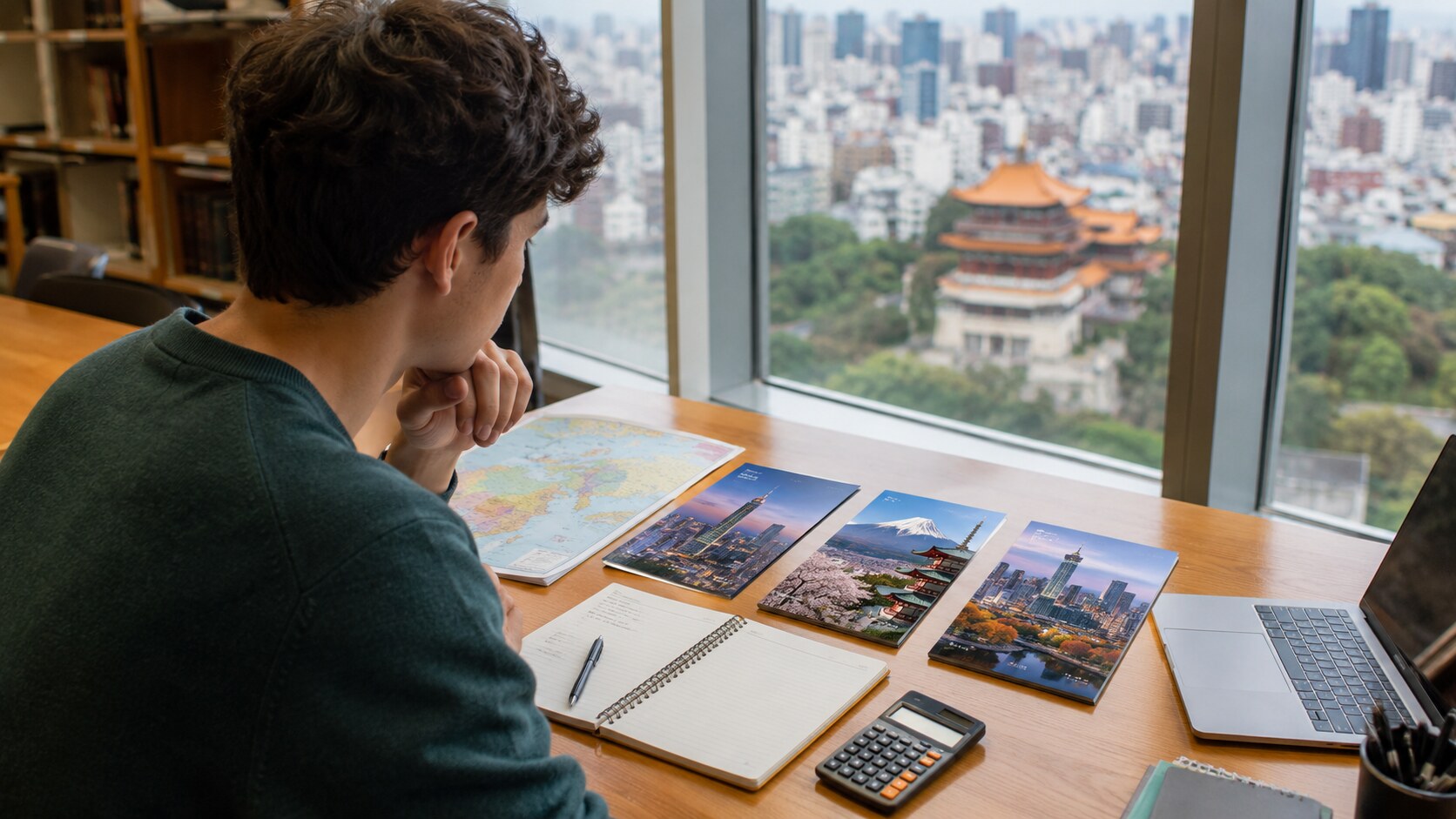
Updated August 2026. Taiwan, Japan and South Korea are three of Asia’s strongest study-abroad destinations. All offer respected universities, safe and efficient cities, scholarships and expanding English-taught options—but the best choice depends on your budget, academic field, language goals and preferred lifestyle.
Taiwan often provides the easiest overall budget of the three, particularly outside Taipei. Tuition varies by institution and field, and university dormitories can reduce housing costs. National Taiwan University publishes a four-month living-cost estimate of NT$48,000–72,000 excluding tuition, with off-campus housing estimated separately at NT$48,000–72,000 for the same period.
Japan’s official averages put first-year undergraduate fees at approximately ¥820,000 for national universities, ¥910,000 for local public universities and ¥1.3 million for private universities outside medicine, dentistry and pharmacy. The official national living-cost estimate is ¥105,000 per month, with Tokyo housing above the national average.
Korean tuition varies widely by university and field. Seoul housing and deposits can raise the initial budget, while regional universities may offer lower costs and stronger tuition incentives. Many universities provide performance-based scholarships covering part or all of tuition.
Cost winner: Taiwan is generally the safest starting point for a cost-conscious student, although a major scholarship can make South Korea or Japan cheaper for a specific applicant.
Taiwan’s MOE Scholarship has historically provided tuition support up to NT$40,000 per semester and monthly stipends of NT$15,000 for undergraduate recipients or NT$20,000 for master’s and doctoral recipients. University awards are also common.
Japan’s MEXT Scholarship can include tuition exemption, monthly support and airfare depending on category. JASSO, universities, local governments and foundations provide additional options, but Japan’s official guidance emphasizes that most scholarships only partially cover total expenses.
South Korea’s GKS may include tuition, language training, airfare and a monthly allowance. Korean universities also frequently offer tuition reductions linked to academic performance or TOPIK results.
Scholarship winner: South Korea has a particularly aggressive university-scholarship environment, while MEXT and Taiwan’s MOE Scholarship remain excellent fully or substantially funded opportunities.
All three destinations offer English-taught programs, especially at graduate level. Japan has a large and varied university system; South Korea has expanded English-track programs; and Taiwan offers English-taught degrees in technology, business, public health and international affairs.
The label “English-taught” is not enough. Ask whether every required module, thesis process and administrative service is available in English. Also check how frequently courses run and whether local-language modules are needed for graduation.
Taiwan is the clear choice for students who want to learn Mandarin while using traditional Chinese characters. Japan offers deep Japanese immersion, while South Korea is ideal for Korean-language development.
You can survive in major cities with limited local-language ability, but language proficiency changes the experience. It expands friendships, internships, part-time work, housing choices and career opportunities.
Country reputation matters less than the strength of the particular department, supervisor, laboratory and curriculum you will actually join.
All three require the correct study and residence permissions for long programs. Taiwan degree students commonly move through a resident-visa and Alien Resident Certificate process. Japan normally uses a Certificate of Eligibility followed by a student-visa application. South Korean degree students generally apply for D-2 status, while many language students use D-4.
Part-time work is regulated in every destination and is not automatically permitted merely because you are a student. Obtain the required permission and confirm current hour restrictions before accepting work.
Taiwan offers compact cities, convenient transport, night markets and easy access to mountains and the coast. Taipei is international and energetic, while Taichung, Tainan and Kaohsiung can feel more relaxed.
Japan provides the widest range of city environments, from Tokyo and Osaka to university towns and regional centers. Public transportation is exceptional, but major-city living can be expensive.
South Korea offers dense urban life, late-opening businesses, strong campus communities and a highly connected digital environment. Seoul is the main magnet, but regional cities may offer a more affordable experience.
The right decision should be based on confirmed admission, net tuition after scholarships, housing, program language and career value—not country popularity alone.
Continue with our detailed guides to Taiwan, Japan and South Korea, or compare the cheapest countries to study abroad in Asia.


Site help, FAQs, blogs, and how our Scouts work